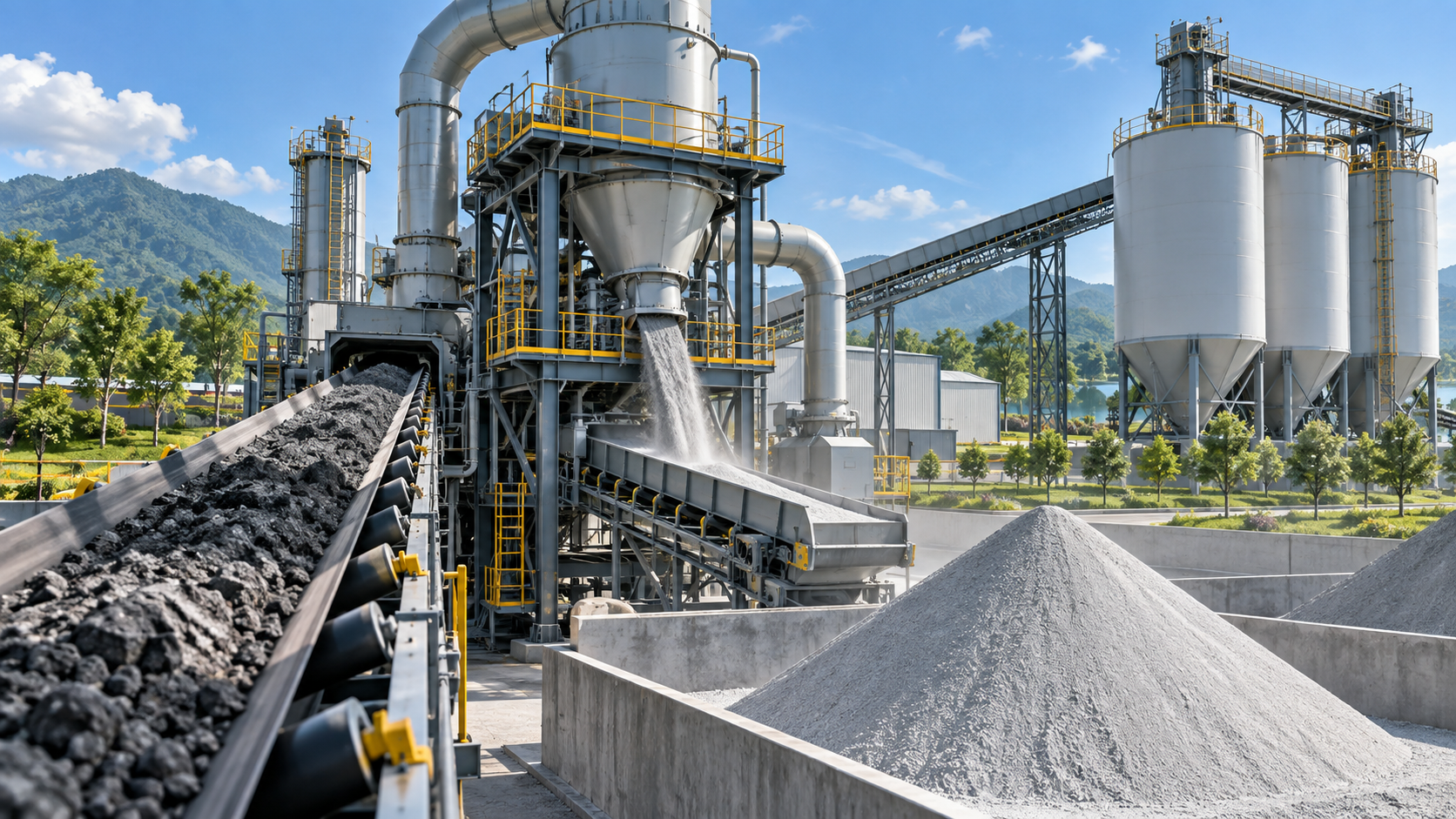
Fly ash separation can upgrade ash with excessive unburned carbon or inconsistent properties into a more useful material for concrete and other applications. ST Equipment & Technology (STET) uses dry triboelectrostatic separation to reduce carbon without water, high temperature combustion, or chemical reagents, improving beneficial reuse while avoiding the wastewater, air emissions, and downstream drying associated with wet processing.
Fly ash can be a valuable supplementary cementitious material, but its usefulness depends on its properties. Excess unburned carbon and inconsistent quality can limit the extent to which some ash sources meet the requirements of concrete producers and other end users.
Fly ash beneficiation provides a way to upgrade those materials rather than sending usable ash to disposal. With the right fly ash processing technology, producers can improve consistency, recover a marketable product, and increase the amount of ash available for beneficial reuse.
Table of Contents
How Does Fly Ash Separation Improve Material Quality?
One of the primary limitations in off-spec fly ash is excessive unburned carbon. High carbon content can interfere with air-entraining admixtures used in concrete, making performance more difficult to predict.
Fly ash separation can reduce this carbon and create a controlled, lower-LOI product for use in concrete. ASTM C618 establishes chemical and physical requirements for coal ash and natural pozzolans used in concrete, including requirements related to fineness, strength activity, water demand, and other material properties.
STET’s process separates the carbon-rich and mineral-rich fractions based on differences in surface charge. Inside the separator, repeated particle-to-particle contact produces triboelectric charging. The charged particles respond differently within an electric field and are conveyed toward opposite ends of the separator.
The result is lower-carbon fly ash with more consistent properties and improved potential for higher-value reuse.
Why Use Dry Fly Ash Processing Technology?
Fly ash beneficiation can be accomplished through several approaches. Some use water, chemical treatment, or thermal processing, each of which brings its own plant and material-handling requirements.
STET’s triboelectrostatic process remains entirely dry. It does not require processed water or chemical reagents, and because the resulting material stays dry, there is no added dewatering or drying stage before storage, transportation, or use. Current commercial separators can process fly ash at rates of up to 45 tons per hour.
Those characteristics can simplify the beneficiation flowsheet while reducing water demand and wastewater generation.
STET reports that its technology has processed more than 25 million tons of fly ash since commercial deployment began in 1995. The company also reports that projects using its technology have enabled customers to save more than 8.5 billion gallons of water and avoid more than 20 million tons of CO₂ emissions.
For more on the connection between beneficial reuse and concrete production, read The Environmental Benefits of Using Fly Ash in Concrete.
Turning More Fly Ash Into a Usable Product
The environmental value of fly ash separation is closely tied to beneficial reuse.
Ash that cannot meet market requirements may otherwise remain in storage or be disposed of. Beneficiation can recover suitable material and increase its value as a concrete or cement input. STET’s controlled low-LOI ProAsh® produced through this process has been approved by more than 20 U.S. state highway authorities as well as other specification agencies.
This gives utilities and ash marketers another option for managing both freshly generated and, when properly prepared, harvested fly ash.
Key Takeaways
- Fly ash separation can reduce excess unburned carbon and improve the consistency of ash intended for higher-value applications.
- STET’s triboelectrostatic process separates carbon-rich and mineral-rich particles based on differences in surface charge.
- Because the process is dry, it does not require process water, chemical reagents, or a downstream dewatering stage.
- Fly ash beneficiation can increase the amount of suitable ash available for beneficial reuse while reducing material sent to storage or disposal.
- The right fly ash processing technology depends on the characteristics of the feed material and the specifications required for the finished product.
Frequently Asked Questions
Can fly ash recovered from landfills or ponds be beneficiated?
Yes, some previously landfilled or ponded fly ash can be processed for beneficial reuse. Recovered material typically requires preparation first, particularly screening, drying, and deagglomeration. STET has tested its triboelectrostatic process on reclaimed fly ash and demonstrated carbon separation after appropriate feed preparation.
What determines whether fly ash is suitable for triboelectrostatic separation?
Suitability depends on the characteristics of the specific feed material and the desired end product. Factors such as carbon content, moisture, particle condition, and other ash properties need to be evaluated before determining the appropriate beneficiation approach. STET’s separator is designed for fine particles and has been commercially applied to both freshly generated and suitably prepared reclaimed fly ash.
Does dry fly ash separation chemically alter the ash?
STET’s process does not rely on chemical reagents to change the ash. Instead, particle-to-particle contact creates differences in surface charge, allowing carbon-rich and mineral-rich particles to be separated in an electric field. The process therefore produces a lower-carbon mineral fraction through physical separation while keeping the product dry.
Conclusion: A Dry Approach to Fly Ash Beneficiation
Improving fly ash quality starts with understanding what limits a particular feedstock and selecting a separation process that addresses those properties.
STET’s dry fly ash processing technology focuses on separating excess carbon from the mineral fraction without introducing process water, chemical reagents, or combustion into the beneficiation step. For suitable fly ash, this can produce a more consistent, lower-carbon material with greater potential for beneficial reuse.
That combination of material upgrading and dry processing gives utilities, ash marketers, and concrete-material producers another way to recover value from an existing industrial byproduct while reducing some of the water, waste, and handling requirements associated with other processing approaches.
Learn more about STET’s fly ash separation technology and how a specific feed material can be evaluated for beneficiation.