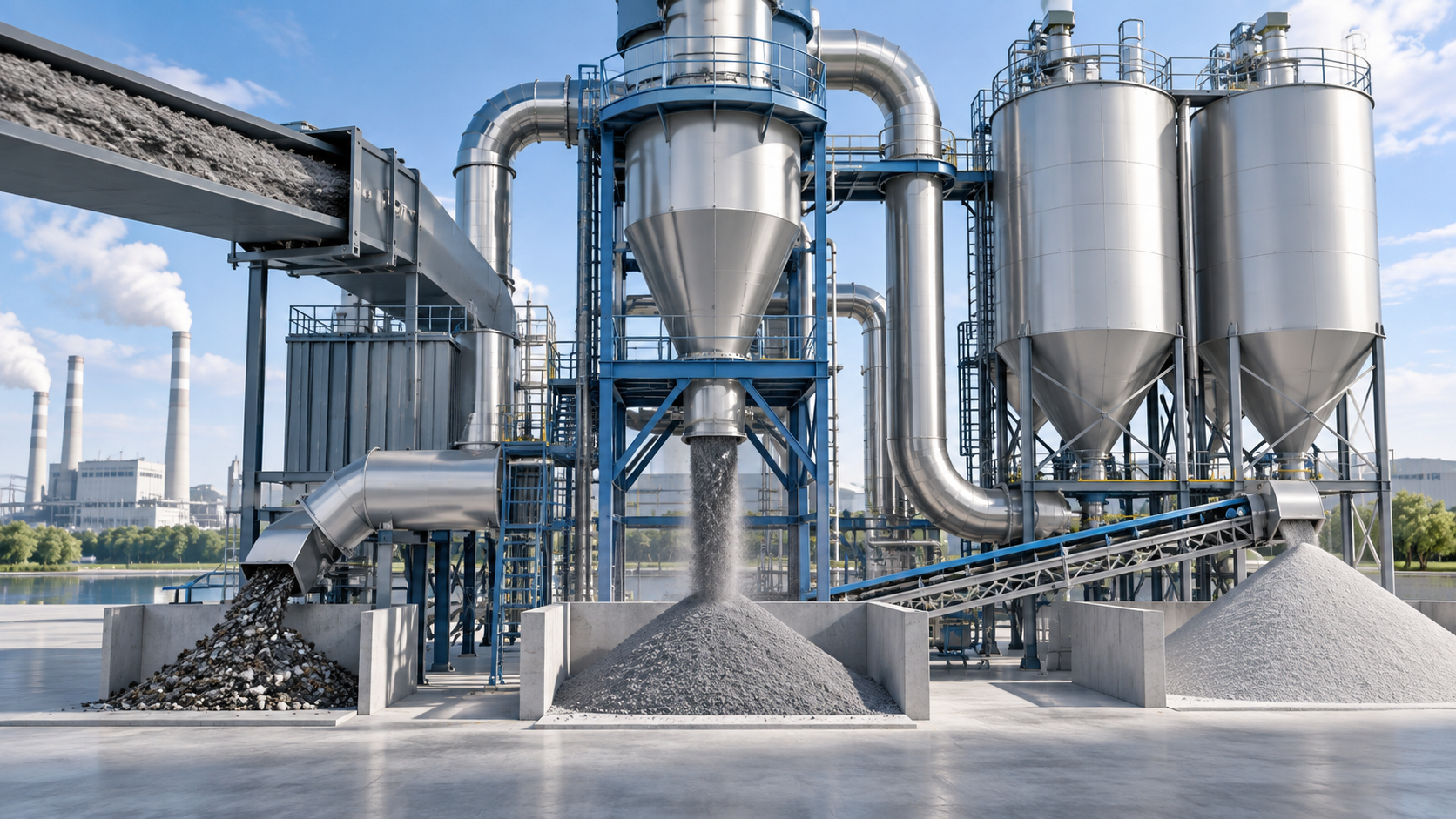
Fly ash separation can reduce disposal volumes and increase the value of suitable ash by lowering excess unburned carbon and improving consistency. STET’s dry triboelectrostatic process separates carbon-rich and mineral-rich fractions without high temperature combustion, process water or chemical reagents, helping utilities and ash marketers recover more material for beneficial reuse.
Fly ash can be valuable as a supplementary cementitious material, but excess carbon or inconsistent properties can limit its use. When suitable ash is sent to storage or disposal instead, operators lose potential product value while continuing to incur disposal costs for that material.
Fly ash separation improves economics by upgrading off-spec ash into a more consistent, lower-carbon product with greater potential for use in concrete and cement applications. The return depends on the feed material, local markets, disposal costs, and product requirements, but the main value drivers are straightforward.
Table of Contents
How Does Fly Ash Separation Reduce Waste and Operating Costs?
Reducing waste starts with recovering more usable material from the ash stream. Fly ash separation equipment can address excess unburned carbon, a property that can limit higher-value reuse.
Improving Ash Quality for Beneficial Reuse
High loss-on-ignition (LOI) can interfere with air-entraining admixtures used in concrete. Reducing the carbon-rich fraction produces a lower-LOI mineral product with more consistent properties.
ASTM C618 sets several chemical and physical requirements for fly ash used in concrete, so carbon reduction alone doesn’t guarantee compliance. It can address an important quality limitation and expand the potential for beneficial reuse when the finished material meets the required specifications.
Avoiding Wet Processing Requirements
Some beneficiation methods rely on water, chemical treatment, or thermal processing. STET’s triboelectrostatic separator remains dry throughout the separation step.
Particle-to-particle contact creates differences in surface charge. An electric field then separates the carbon-rich and mineral-rich particles while a high-speed belt conveys them toward opposite ends of the separator. Because the material remains dry, the process doesn’t add wastewater, dewatering, or downstream drying to the flowsheet.
What Drives ROI From Fly Ash Separation Equipment?
The potential return from fly ash processing equipment comes from increasing material value while reducing costs associated with handling material that otherwise can’t reach its intended market.
Recovering More Value From the Ash Stream
The lower-carbon mineral fraction can be used as a pozzolanic material when it meets applicable product requirements. The separated carbon-rich fraction may also have value as fuel in suitable plant configurations.
That creates an opportunity to recover value from more of the incoming material rather than treating the entire off-spec stream as waste. The actual economics depend on the feed, end markets, transportation, and how each product fraction will be used.
Reducing Water, Air Emissions, and Disposal Requirements
Dry processing avoids process water and the associated wastewater handling and downstream drying stages. Because STET’s triboelectrostatic process does not rely on high-temperature combustion, it also avoids introducing combustion-related air emissions as part of the separation step. Beneficiating suitable ash can further reduce the amount of material that remains in storage or is disposed of.
Quick Fact: STET has processed more than 25 million tons of fly ash, helped customers save more than 8.5 billion gallons of water, and enabled the avoidance of more than 20 million tons of CO₂ emissions.
Learn more about STET’s fly ash processing technology and how dry separation can fit into a beneficiation strategy.
For more background on the role of beneficial reuse in concrete production, read The Environmental Benefits of Using Fly Ash in Concrete.
Key Takeaways
- Fly ash separation can reduce excess unburned carbon and improve the consistency of suitable ash.
- Dry triboelectrostatic separation doesn’t require high temperature combustion, process water or chemical reagents.
- ROI can come from recovering a higher-value mineral product, reducing disposal volumes, and avoiding wet-processing requirements.
- The carbon-rich fraction may also have a useful outlet in suitable plant configurations.
- Feed characteristics and end-product requirements should be evaluated before selecting fly ash separation equipment.
Conclusion: Building a Stronger Business Case for Fly Ash Beneficiation
Fly ash separation can create value by turning material with limited reuse potential into a more consistent product for higher-value applications. For operators, the business case depends on more than separation efficiency. Disposal costs, available markets, feed preparation, transportation, and finished-product specifications all affect the return.
STET’s dry process provides one way to address excess carbon without introducing process water or chemical reagents into the beneficiation step. For suitable fly ash, this can support greater beneficial reuse while keeping the processing flowsheet relatively simple.
FAQs
Can Reclaimed Fly Ash Be Processed With Dry Separation Equipment?
Yes, some landfilled or ponded fly ash can be beneficiated after appropriate preparation. Reclaimed material may need drying, screening, and deagglomeration before separation, depending on its condition.
Does Fly Ash Separation Guarantee ASTM C618 Compliance?
No. Carbon content is only one part of fly ash quality. The finished product must meet the applicable chemical and physical requirements for its intended use.
What Happens to the Carbon-Rich Fraction?
In some STET installations, the recovered high-carbon fraction can be returned as fuel or used in another suitable application. The available outlet depends on the plant configuration and material properties.
Evaluate Your Fly Ash for Beneficiation
Feed characteristics determine what separation approach makes sense. Contact the STET team to discuss your ash, product targets, and processing requirements.