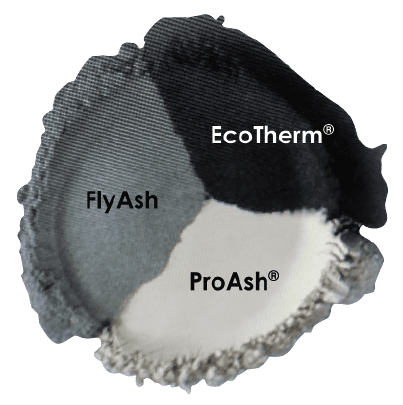
Fly ash is the fine mineral residue left over from burning coal by coal-fired power plants. Fly ash is pozzolanic, meaning that it has cementitious properties. It is valuable for use in ready-mix concrete as a partial replacement for Portland cement. Also, it may be used in the manufacture of other building materials such as bricks, tiles, and blocks. Because of these properties, fly ash concrete applications continue to grow across modern construction and material manufacturing.
The addition of fly ash in concrete mixes offers several benefits for construction purposes. It is also valuable from an environmental perspective, with several sustainability benefits of using fly ash in concrete. For one, leftover fly ash won’t need to be sent to landfills. For another, producing cement requires a high-temperature calcination process that releases CO2 emissions. If every pound of fly ash is used to replace cement in concrete, nearly one pound of CO2 is prevented from entering the atmosphere. This is one reason fly ash in concrete industry applications is often associated with more sustainable material use and lower embodied carbon. For construction purposes, fly ash in ready-mix concrete offers several advantages versus normal Portland cement-only concrete, including –
Table of Contents
Why Is Fly Ash Used in Ready-Mix Concrete?
Fly ash in concrete is widely used because it helps improve both performance and efficiency. When added in the right proportion, it can enhance long-term strength, improve consistency during placement, improve workability, reduce water demand, and reduce the amount of Portland cement needed in the mix. This makes fly ash concrete a practical option for contractors, producers, and project owners looking for both technical and economic benefits.
Holds High Durability
Concrete mixed with fly ash requires less water for production, which creates a denser product that is less prone to shrinking. This makes it stronger and less prone to cracking or permeability. Less permeability provides great cold-weather resistance by keeping moisture and road chemicals out, which can shrink and expand as temperatures vary by season.
Improves Concrete Workability
The spherical shape of fly ash particles helps to facilitate the movement of the concrete, even at reduced water compared to normal concrete. This makes it easier to pump, easier to place, and easier to mold, and it creates a smoother finish with sharp details.
Economical for Concrete Production
Cement is the most expensive component of ready-mix concrete. By using fly ash as a substitute, it can create a better product that is less expensive to produce. A better product that is cheaper to make is a blessing for those watching the bottom line. Raw, untreated fly ash often contains residual coal char, or carbon, which can impact its performance or even its ability to be used in concrete.
What Role Does Processing Play in Fly Ash Quality?
Not all fly ash performs the same way. Its value in ready-mix concrete depends heavily on quality, consistency, and carbon content. If the ash contains too much residual carbon, it may affect air entrainment, mix behavior, and overall usability. That is why proper beneficiation or separation is essential before using fly ash in concrete, especially when historic coal ash harvesting is used to recover material for beneficial reuse.
Understanding the STET Process
The ST Equipment & Technology electrostatic separation process can treat raw fly ash by removing the unwanted residual coal char. The resulting product is a mineral-rich concrete grade, trademarked ProAsh®. The STET process can be used on both fresh and historically produced landfilled or impounded fly ash.
This process helps expand the usable supply of ash for fly ash cement and ready-mix applications by upgrading materials that might otherwise be overlooked. It also supports the recovery of previously discarded ash sources, creating additional value for producers and helping reduce waste.
How Does Fly Ash Support Sustainability in Construction?
Fly ash supports sustainability in several ways. It diverts industrial byproducts from landfills, reduces the demand for Portland cement, and helps lower greenhouse gas emissions associated with cement production. In addition, using recovered or beneficiated ash creates a more circular material stream. For builders and manufacturers focused on performance and environmental responsibility, fly ash in concrete industry applications offers a practical path forward.
Key Takeaways
- Fly ash improves concrete durability by reducing permeability, shrinkage, and cracking.
- It enhances workability for easier pumping, placement, and smoother finishes.
- It lowers production costs by reducing Portland cement use.
- Proper processing improves fly ash quality and usability.
- It supports sustainability by cutting waste and emissions.
Turn Fly Ash Challenges Into Higher-Value Results with Steqtech!
Fly ash offers clear benefits in ready-mix concrete, from better durability and workability to lower material costs and improved sustainability. When processed properly, it becomes a more consistent and valuable material for modern construction applications. STET’s electrostatic separation equipment helps remove unwanted carbon and upgrade ash for higher-quality use in concrete. To improve fly ash performance and recover more usable material, consider exploring STET’s advanced separation solutions.
Frequently Asked Questions
What is the difference between Class C and Class F fly ash in concrete?
Class F fly ash is highly pozzolanic and improves chemical resistance, while Class C fly ash possesses self-cementing properties. Class C typically offers higher early strength, whereas Class F provides superior sulfate resistance.
Does using fly ash affect the setting time of ready-mix concrete?
Yes, fly ash generally extends the initial and final setting times. While this improves workability in hot weather, it may require setting-time adjustments or chemical accelerators during cold-weather pours to maintain schedules.
How does fly ash impact the early-age strength of concrete structures?
Fly ash concrete typically gains strength more slowly than pure Portland cement mixes during the first 7 days. However, due to continued pozzolanic activity, it often exceeds conventional concrete’s strength by 28–90 days.
Can fly ash be used in architectural or decorative concrete applications?
Yes, though it may slightly darken the mix or cause color variations. When processed for consistent carbon content, fly ash creates a smoother surface finish, making it ideal for detailed architectural molds.